
Looking for services that help brands collect and curate UGC videos? Here are 5 real options with honest pros and cons, and a clear guide on which approach suits which situation.
You have decided to invest in UGC video. You have seen the results other brands are getting. Your paid social performance has been plateauing and you know that fresh, authentic creative is part of the answer. The problem is that the moment you start looking into how to source UGC at scale, the options feel overwhelming.
Creator platforms, freelance marketplaces, full-service agencies, AI tools, in-house programmes, they all claim to solve the same problem but work in completely different ways and suit completely different situations. Here is an honest breakdown of five real options, with clear guidance on which approach makes sense for which type of brand or campaign.
Option 1: UGC Creator Platforms (Influee, Billo, Minisocial)
Creator platforms are the most structured way to source UGC at scale. The model is straightforward: brands submit a creative brief, creators apply to it, and once selected, they film and deliver the content within an agreed timeline. The platform handles payment processing, content rights, and communication, removing most operational friction.
Influee is currently the largest UGC platform in the UK and US markets. It has a substantial creator database across a wide range of content categories. Billo is more focused on short-form video ads specifically and is particularly popular with e-commerce brands running performance campaigns on Meta and TikTok. Minisocial and Trend.io are smaller but useful alternatives for brands wanting a more curated creator experience.
The main limitations are turnaround time (typically 7 to 14 days) and variability in quality. Even with a detailed brief, different creators interpret instructions differently, and the revision process can extend timelines significantly.
Option 2: Freelance Creators (Fiverr, Instagram, TikTok, Shopify Collabs)
Sourcing UGC creators directly, through platforms like Fiverr, Upwork, outreach on Instagram, TikTok, Facebook Reels, or through Shopify Collabs, is a more hands-on approach that gives you more flexibility and typically a lower cost per video.
Shopify Collabs in particular has become one of the most efficient ways for e-commerce brands to connect with creators, especially those already familiar with the DTC space. Creators can be compensated through affiliate commissions, free products, or flat fees, which makes it adaptable to different budget structures. This is also an increasingly important keyword in the UGC creator space.
Direct outreach on TikTok and Instagram is still highly effective for finding creators who already make content in your product category. Fiverr and Upwork give you access to a large pool of creators offering UGC services at varying price points, with the advantage of seeing previous work and reading reviews before committing.
The tradeoff with all direct sourcing approaches is time. You take on the vetting, briefing, communication, and rights management yourself. For a single campaign this is manageable. For ongoing UGC production at scale it becomes a significant operational burden.
Option 3: Full-Service UGC Agencies
A growing number of agencies specialise in end-to-end UGC production, from creative strategy and creator sourcing through to brief writing, editing, performance tracking, and creative iteration. This is the right choice for brands with larger budgets and limited internal bandwidth.
Instead of managing creators yourself, you hand off the entire process and receive finished deliverables with strategic context. The agency handles quality control, revisions, and performance analysis. The main limitation is cost, full-service UGC agencies charge a management fee on top of creator costs, which makes the overall cost per video significantly higher than sourcing directly. For smaller brands testing UGC for the first time, it is usually not the right starting point.
Option 4: AI-Generated UGC Tools (Including Anivision AI)
AI-generated UGC is the fastest-growing segment in content production right now, and for good reason. Tools like Anivision AI use AI avatars and proven direct-response script frameworks to produce UGC-style video content without requiring a human creator to film anything.
The workflow is simple: you input your product details and campaign objective, the platform generates scripts using proven performance frameworks, you select an avatar and customise the delivery, and you export multiple video variations ready for testing. What would take two weeks through a creator platform can be done in a matter of hours.
The important caveat is authenticity. AI-generated UGC does not carry the same genuine human quality as content from real creators. The most effective approach for most brands is to use AI UGC to find the winning creative angle efficiently, then invest in real creators to produce the authentic version of that winning concept. Tools like Anivision AI work best alongside a real creator strategy, not as a replacement for it.
Option 5: In-House Customer Submission Programmes
The most authentic UGC possible comes from real customers who genuinely love your product and want to share their experience. Building a system to capture that content, through post-purchase emails, loyalty programme incentives, packaging inserts, or social contests, produces content that no brief can fully replicate.
The challenge is that this approach takes time to build and is difficult to control. You cannot brief a customer the way you brief a creator. The content you receive will vary enormously in quality, format, and messaging. For brands with a strong customer community and a long-term content strategy, in-house UGC is worth investing in systematically. For brands that need content now, it is not a reliable primary source.
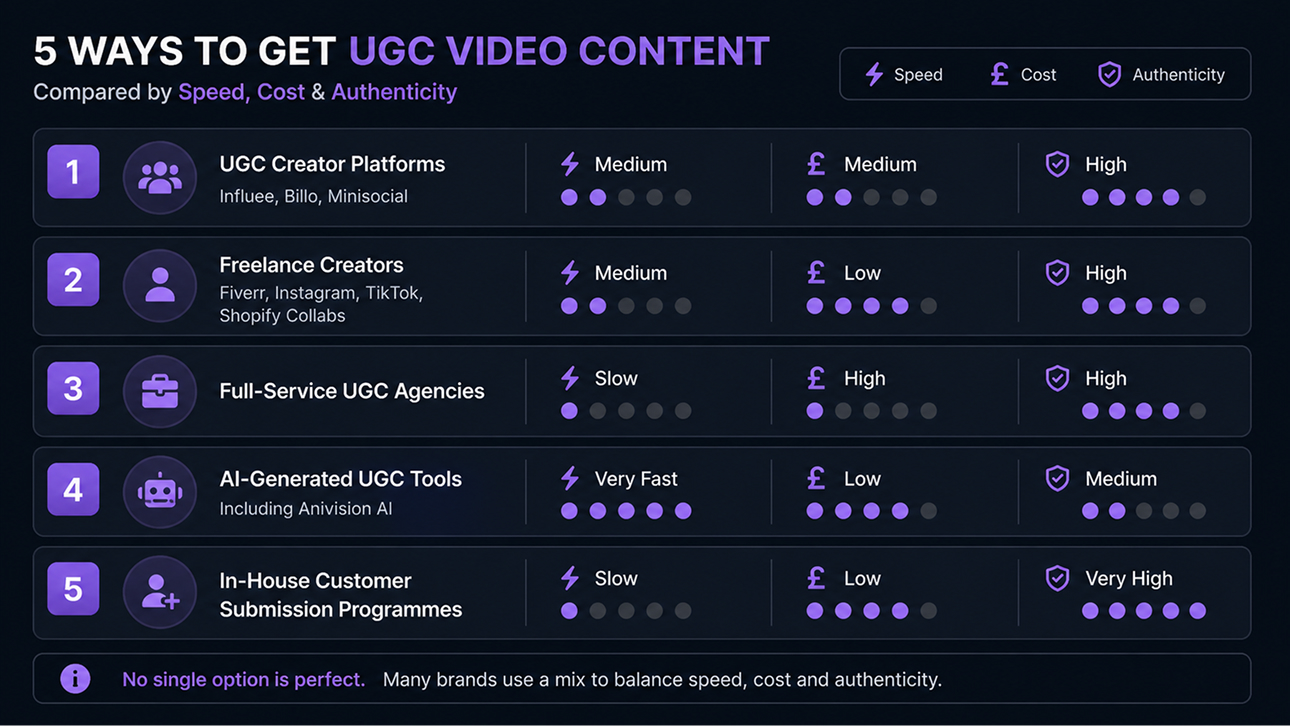
5 ways to get UGC video content for your brand, compared by speed, cost, and authenticity. (AI-generated diagram)
Case Study: Gymshark
Gymshark was founded by Ben Francis in a garage in Birmingham in 2012. With no budget for traditional advertising, Francis built the brand's early content strategy almost entirely around UGC and community-driven content. Rather than relying on a single source, Gymshark used multiple channels simultaneously.
They ran structured campaigns through creator platforms to source high-quality UGC for paid ads. They built an in-house submission programme through the branded hashtag #Gymshark, which generated thousands of pieces of organic customer content over time. And as AI UGC tools became available, they used them to test creative angles before committing to full creator briefs.
The result was a content operation that could produce consistently high volumes of authentic-feeling content at a cost structure traditional production could not match. Gymshark grew from zero to a $1.45 billion valuation in ten years, with UGC as the backbone of their content marketing throughout.
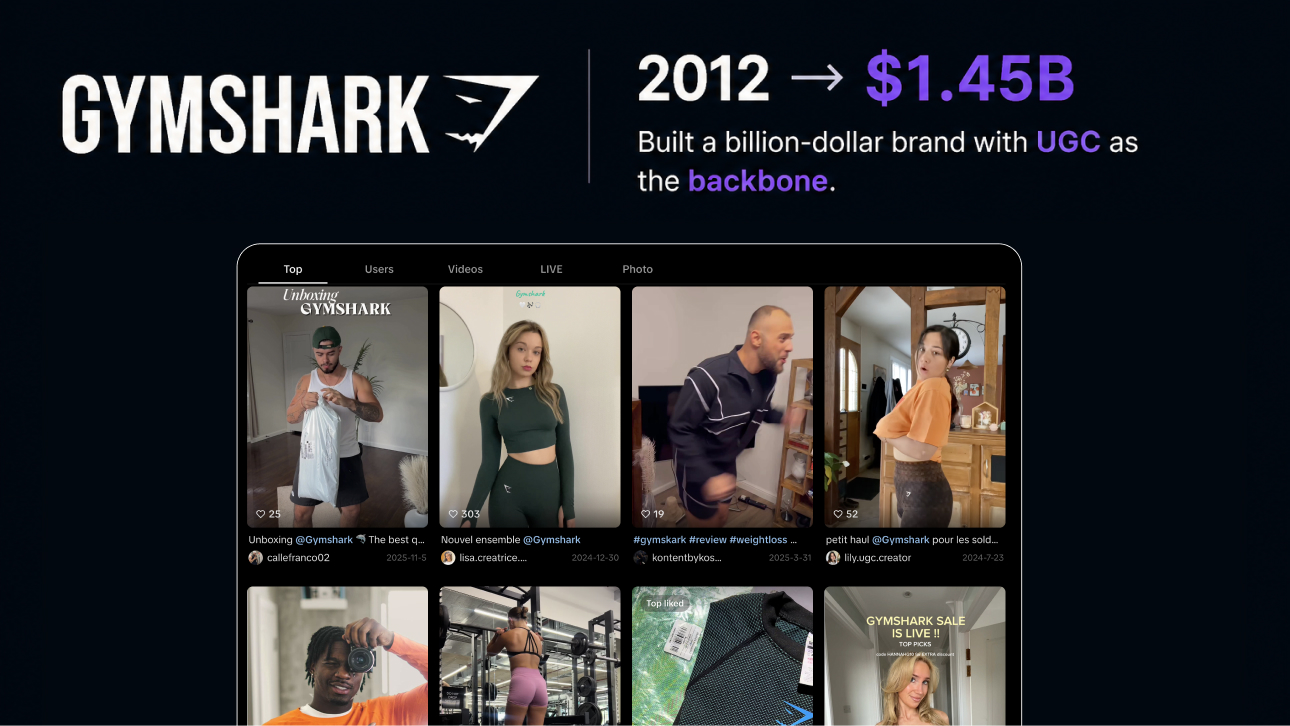
UGC content on TikTok: product demonstrations and creator-led brand content in the UK market. Source: TikTok (search: ugc video)